skip to main |
skip to sidebar
11. February. 2010
Venezuela on Wednesday awarded the largest oil investment of President Hugo Chavez's 11-year rule, drawing tens of billions of dollars of much-needed foreign finance to the Orinoco Belt just three years after the leftist leader nationalized operations there.
U.S.-based Chevron and Spain's Repsol led groups that will tap into the OPEC member's 100-plus billion barrels of reserves, as oil giants struggle to replenish waning crude reserves that are increasingly under control of producer nations.
The results show victories for both sides. Oil companies agreed to tough conditions laid down by Caracas while Venezuela softened some fiscal terms, in another sign of dwindling resource nationalism around the world sparked by falling oil prices.
"This international investment is absolutely necessary for us, we could not develop the Orinoco Belt alone," Chavez told oil company officials during a ceremony in the Miraflores presidential palace.
"This is mutually beneficial. You are here because you need to be here. These are relationships of equals, of friendship."
Chavez, known for his jocular manner and combative anti-U.S. politics, spent several minutes lambasting U.S. President Barack Obama, even requesting that Chevron's regional chief help Venezuela improve ties with Washington.
"Maybe Obama will come to the Orinoco Belt, bring him," Chavez said.
Analysts say the world's reserves of easy-to-produce light oil are quickly running out, meaning the future of the industry is in difficult production areas such as the Orinoco Belt, Brazil's deep water fields or Canada's tar sands.
"It is pragmatism on the part of the Venezuelans and international oil companies," said Jeremy Martin, director of the energy program at the Institute of the Americas in California.
"The Venezuelans know they can't do this without major capital and knowhow, and (companies) know there's nowhere else in the world where they would have access to world class reserves like these."
Venezuela's oil production has fallen below 2.5 million barrels per day (bpd) from more than 3 million bpd in 2001, according to the U.S. Department of Energy, due principally to limited oilfield investment and lack of qualified personnel.
PDVSA's own official statistics show output above 3 million bpd, though even those numbers have been flat for five years. The e company has twice in the last five years pared down aggressive production increases.
Repsol will take 11 percent in its project, the same stake as consortium partners Petronas PETR.UL of Malaysia and ONCC of India. State oil firm PDVSA will take 60 percent, with two other Indian companies taking the remainder, a Repsol official said.
Chevron will lead a second project along with consortium partners that include Japan's Mitsubishi and Inpex (1605.T), plus Venezuela's Suelopetrol SPTb.CR. Japanese government affiliated Japan Oil, Gas and Metals National Corp was not included in the winners, despite having been part of the negotiations.
The government did not receive offers for a third project and did not receive bids from several companies Chavez has openly courted, including China's CNPC and Russian firms such as Lukoil and Gazprom.
This may be in part because Venezuela is running a parallel process of direct adjudication for blocks in the Junin area of the Orinoco belt.
BIG REWARDS, BIG RISKS
Venezuela holds the world's fifth-largest oil reserves at an estimated 100 billion barrels, according to the BP Statistical Review. The Venezuelan government says it holds at least 210 billion barrels that could yet be produced.
But companies face a host of risks including a major financing burden, a massive infrastructure buildout, and the liability that Chavez could launch another wave of state takeovers.
In 2007 Chavez took over operations of four Orinoco projects, leading U.S. giants Exxon Mobil (XOM.N) and ConocoPhillips (COP.N) to leave the country and sue Venezuela.
[Reuters]
10. February. 2010
morssglobalfinance (by: Elliott R. Morss)
In recent articles, both on this subject and on Gary Shilling’s 2010 recommendations (Gary should stick to real estate), I have argued for investments in Southeast Asia, Latin America, and South Africa. There have been two primary reasons for this position:
the heavy overload of debt in the US, Europe, and Japan, and more importantly,
the projected rapid economic growth rates of these emerging market countries.
Here, I will not repeat my detailed arguments but instead want to bring your attention to a remarkable interview Monday night (February 8th) with Eike Batista on the Charlie Rose show. The interview will be available in the next 12 hours on the Rose web site. It is one hour long. I urge you to listen to it in its entirety.
Batista’s father ran Cia. Vale do Rio Doce which is the world's largest iron ore exporter. His father would not let any of his children get involved in Vale - “no nepotism”. Batista, with his own investments in iron ore, Brazilian infrastructure, and oil, is on a growth path to be the world’s richest man in less than a decade.
But what makes his interview exceptional is his view of global growth. He points out that Brazil now has everything: a great natural resource base (offshore oil discoveries are real – he believes Brazil will shortly have proven oil reserves that will make it the 5th largest in the world, a strong manufacturing sector, and leadership that understands how to work with business. Brazil was affected in a very minor way by the Western banking collapse and the ensuing global recession. Why? In part because only 14% of its GDP is exported, and in part because of its growing middle class.
A lot of Batista’s business is with the Chinese. He is building ports and other facilities to ship iron ore, soy, and soon oil to China. He his great admiration for what is happening in China: “A billion-person middle class – they quickly became the low cost/high quality producer of everything: they are unstoppable.” But China is natural resource poor and they need to buy them from Brazil and other natural resource rich countries.
He sees Brazil, Chile, and Colombia as the solid economic countries in Latin America; he is not happy about the “populism in Argentina (too bad, such a rich country), Ecuador, and Venezuela. He is sympathetic to the revolution in Bolivia (“it had too happen – Bolivia has been exploited for 400 to 500 years”). He said Peru has to develop a greater concern for its poorer people before it will be stable politically. And he is decidedly not enthusiastic about Mexico.
I feel pretty much the same way about Latin American countries as a result of the studies I did with my students last November at the Business School at the University of Palermo in Buenos Aires on how they were dealing with the global recession. On Mexico, see my posting here.
Batista was not enthusiastic on economic prospects for the US, Europe and Japan. He believes the tremendous debt overhang will plague these countries for more than a decade. He noted that Brazil had its own problems with overspending, inflation and debt back in the 1960 - 1990s period (at one point, debt service payments exceeded 80% of exports). It took Brazil more than 10 years to break the cycle and he expects it will be the same for Western nations.
He noted that it takes a long time for investors (and the rating services) to regain confidence once it is lost.
I repeat: if you want to understand the future of the global economy, listen to Batista’s interview in its entirety.
I will post specific investment suggestions for countries in Latin America, Southeast Asia, and South Africa in the next two weeks.
10. February. 2010
Seeking Alpha (By: Dian L. Chu)
European and U.S. stock markets have taken a hit recently, as spooked investors from Shanghai to Sao Paolo were fleeing risky assets.
This flight took place amid concern that the financial crisis in Portugal and Greece could spread through the eurozone, with vast implications for the fate of the fragile global economic recovery. (Fig. 1)
Liquidate & Buy Dollar
A steep drop in crude-oil prices triggered declines across the commodities spectrum, as investors nervous about the pace of the economic recovery gravitated back to the dollar. Crude oil tumbled to a seven-week low of $71.19 a barrel last Friday, down 14% since the 2010 high of $83.18 reached on Jan. 6.
Investors’ flight to safety drove the U.S. dollar near a nine-month high against the euro. Emerging market currencies also weakened in Asia, while U.S. stocks fell a fourth straight week, the longest streak since July.
A Shift of Sovereign Risk
According to EPFR Global, risk aversion has prompted a withdrawal of $1.6 billion from emerging market equity funds during the week ending Feb. 3, the biggest outflow in 24 weeks, and $516 million has left Asian equities outside of Japan.
The charts from CDR (Credit Derivatives Research) tell the story of this investor's perception.
According to CDR, there has been a dramatic shift of risk in developed nations relative to emerging and less-developed nations when comparing three sovereign risk indexes, SovV, EM and CEEMEA. (Fig. 2)
In SovX, the GIPSI (H/T Zero Hedge) - Greece, Italy, Portugal, Spain and Ireland, represent around 65% of the index risk. In EM, Venezuela accounts for 26%, Turkey, Brazil, and Argentina represent 12% respectively of the EM risk. In CEEMEA, Turkey and Russia represent 49% of the index risk (followed by Hungary and Ukraine each at over 8%).
In addition, CDR finds that the sovereign risks of the emerging economies appear to be closely tied to the price of oil:
“It would appear that the CEEMEA and EM sovereign risk indices are threatened more by commodity price pressures than credit risk currently - and given the 'relatively' high price of oil/gas, their risk remains less of a concern than developed nations where the Ponzi appears to be in question.”
Oil Price - A Key Risk Factor
Emerging market countries, such as Brazil, China or India, are evolving since the early 90s. During this period, the issuance of bonds by these countries has increased significantly, reflecting their needs for substantial long term and infrastructure investment.
Among the many determinants of risk bonds, the price of oil is a key factor as it plays a significant role in economic growth, inflation, production costs, trade balances and currency. Nine of the ten economic recessions in the United States since the end of World War II were preceded by a dramatic increase in the price of oil.
A Sensitivity Issue
Oil prices nowadays are extremely volatile, and sharp fluctuations in oil prices contribute to macroeconomic volatility all over the globe. The impact of this volatility on economy varies according to a country’s relative dependence on oil production and exports.
For oil-exporting countries like Russia and Saudi Arabia, a rise in oil prices caused a perception of risk reduction relative to its obligations. Conversely, an oil-importing country sees its risk index increase due to a barrel price shock.
Financial Crisis 2.0?
Last week's wild commodity price swings underscore how investors aren't totally convinced that the world economy is on an upward trajectory. Investors are worried that multi-governments' debt problems will spread globally, similar to the subprime crisis in 2008.
In addition to concerns about GIPSI sovereign debt defaults in the 16-nation eurozone, the U.S. is grappling with its own deficits and the high jobless rate, while China began restricting lending last month to prevent high inflation.
Some analysts expect global commodity prices will eventually firm up, reflecting economic recovery albeit high volatility; and fundamentals should increasingly dominate expectations and drive prices.
But there are others who see the current “correction” as caused by factors very similar to those that brought on the “financial crisis of 2007-2010” and warned this could signal “a new crisis in development.”
Seeking Negative Beta
In this environment, a defensive play would be to invest or allocate a portion in regions that are less prone to the price of oil, which is a significant sovereign risk factor. Sector-wise, agriculture and alternative investment vehicles in real estate or land development should provide some good diversification to any long term portfolios.
Jeff Rubin, Chief Economist at CIBC World Markets pointed out that the United States is less sensitive to oil price volatilities because it is itself an oil producer (5 million barrels out of 19 million barrels the US consumes are produced in the US), so it receives some of the benefit of both higher and lower oil prices.
An IEA analysis also indicated that the U.S. should be less affected by oil price shocks than Japan, OECD and eurozone. (Fig. 3)
This competitive edge probably partly explains how investors still see the U.S. dollar as a safe haven, and Mr. Geithner's optimism that more debt won't hurt U.S. credit rating, in spite of the fiscal and economic challenges quite similar to what the eurozone is facing.
BRIC minus R
In addition to the United States, GDP growth in Brazil, China and India could get a boost from the softening and stabilizing of oil prices and should increase their competitiveness. Brazil and Chindia are all oil producers with aggressive state-sponsored exploration and production efforts and strong economic growth prospects. Brazil, with a new and improved investment grade credit rating, is now largely self-sufficient and has insulated its economy from oil price shock on net basis.
The economic impact of oil prices on oil-importing, developing countries such as China and India could be more pronounced primarily because Chindia are more energy-intensive due to its strong growth rate, and less energy efficient. From that perspective, Chindia, though good prospects, could be more of a roller-coaster ride for investors.
Among the emerging economies, lower crude oil prices will be a big dampener for the Russian economy. Russia's two oil wealth funds declined by a total $1.54 billion over the last month, as more funds were transferred to aid federal budget shortfalls. The Reserve Fund, one of Russia’s two oil wealth funds, is expected to run out by the end of 2010.
8. February. 2010
Aljazeera
Argentina has lodged a protest with the UK over London's plans to begin offshore oil exploration off the north coast of the disputed Falkland Islands.
Jorge Taiana, the Argentinian foreign minister, said that Argentina "firmly rejects" the UK's plans to authorise oil and gas exploration "in the Argentine continental shelf area".
"We will do everything necessary to defend and preserve our rights," he said on Tuesday, following a meeting with British embassy officials in Buenos Aires.
Local media reported that Desire Petroleum, a British oil company, is soon to start exploration drilling off the coast of the Falkand Islands.
The islands, known as the Islas Malvinas in Spanish, have been under British control since 1833, but Buenos Aires considers them part of Argentine territory.
In 1982, Argentina and Britain fought a 74-day war over the islands in which almost 1,000 people were killed, and tensions over the islands continue to simmer.
Indications that there could be large oil reserves around the Falklands have raised the stakes in the sovereignty dispute.
Buenos Aires says that the UK continues to skirt UN resolutions calling on both governments to renew a dialogue on the sovereignty of the South Atlantic archipelago.
Britain last month rejected Argentina's latest claim to the islands.
5. February. 2010
Seeking Alpha (The business Insider)
Sovereign debt concerns have exploded this year, and the chart below makes this fact very clear.
It shows short-selling interest for the sovereign debt of different nations, as calculated by short-interest firm Dataexplorers in a February report.
Dataexplorers presents Short interest as an alternative to using credit default swap data alone: "CDS data on these markets is well publicized, but what does short selling data tell us about the current market attitude to developing country government bonds?"
The degree of recent short selling is indicated by the blue bars, while that of one year ago is in red. Longer bars implies far more traders betting against a nation's debt.
What is particularly striking about the data is that while some of the infamous European sovereign-default-risk PIIGS (Portugal, Italy, Ireland, Greece, and Spain) rank highly on this list of troubled nations, many Eastern European nations look far worse in terms of short interest. Note some PIIGS aren't in the table, they might not have been included in Dataexplorer's screen.
If the shorts are right, Eastern Europe may actually be the spark that sets off the rest of Europe's financial crisis. Note Abu Dhabi shot up this year as well, no doubt due to Dubai's crisis.
31. January. 2010
AliBaba News
The US Department of Commerce (DOC) has decided to extend the time limit for the preliminary results of the antidumping (AD) duty administrative review on stainless steel bar from Brazil.
According to a statement issued in the Federal Register on January 26, the DOC has extended the deadline for the preliminary results for the review from January 29, 2010 until March 1, 2010. The review, which covers the period from February 1, 2008, through January 31, 2009, concerns Villares Metals S.A.
The product is currently classified under subheadings 7222.10.0005, 7222.10.0050, 7222.20.0005, 7222.20.0045, 7222.20.0075, and 7222.30.0000 of the Harmonized Tariff Schedule of the United States (HTSUS).
The final results are to be issued no later than 120 days after the publication of the preliminary results.
26. January. 2010
Gregor macdonald (Seeking Alpha)
Each year brings fresh updates to the body of peak oil research but I thought the recent An Explanation of Oil Peaking, R.W. Bentley, University of Reading 2009 was particularly good reading. Bentley does such a good job of explaining in direct terms a simple model for peak oil, without excluding any of the attendant complexity. (This would be a very good introduction for someone new to the subject).
I especially liked his articulation of how the total production arc for, say a country or a region, is a sequence composed of the largest fields eventually giving way to many smaller fields. That description made me think of the post-peak production profile of the United States, with its long-life extension at levels well below the 1971 peak. And, it also brought to mind Mexico.
The chart you see here includes the latest updated production. Total crude oil for the month of December comes in at 2.590 mbpd. This is a slight uptick to November’s 2.553 mbpd. Of course, the real story in the chart is that Mexico can never, and will never, get back to its peak year of 2004. The fact that the country’s oil minister(s) has been claiming it would, over the past five years, is actually kind of sad. And if you read Bentley’s paper you’ll understand more fully the reasons why.
Now that Mexico has lost its largest oilfield, Cantarell, which did a fast crash over 3-4 years and is the central thrust behind the above chart it’s now likely that Mexico’s crude oil production will tail off at a gentler decline rate. If Cantarell became inoperable for some reason then a new, fast leg down in supply would of course unfold. But, barring such an occurrence my guess now would be that much of the acute phase of the decline is over. Or, about to be over.
As Mexico moves into the chronic phase of its decline you will hear about new technologies, new discoveries, and increased production from some existing fields. Perhaps Mexico will even change its constitution, and allow western exploration companies to enter with their engineers and high-tech equipment. No doubt the Mexican government will claim, just like poorly written journalism here in the States often claims, that these developments have a chance to meaningfully lift production. Again, the data shows that’s simply not the case at all. For the explanation, read Bentley.
26. January. 2010
Carl T. Delfeld
As I predicted, Mr. Sebastián Piñera, a billionaire tycoon and former senator has been elected as Chile’s new president.
With 99 percent of the vote counted, Mr. Piñera, 60, had 52 percent, to 48 percent for Eduardo Frei, 67, a former president. After the first official results were released, Mr. Frei conceded, calling the defeat “just a bump in the road.”
Mr. Piñera’s main campaign theme was his business experience and how he would focus on growing Chile’s already vibrant economy.
During the campaign, Mr. Piñera said that he would create one million new jobs and crack down on delinquency and drug trafficking. He also said he would seek to privatize a part of Codelco, Chile’s state-owned copper company and the world’s largest copper producer.
Chile’s economic performance used to be among the weakest of the Latin American countries, with annual increases of real GDP per capita averaging only 0.76 percent from 1913 to 1983. Then a series of market reforms and trade liberalization supercharged Chile’s economy, and annual growth in per capita output since 1983 has averaged an impressive 4.2 percent per year.
As these reforms took hold, the annual return for Chile’s stock market has averaged 15 percent per year since 1988, meaning that stocks have doubled in value almost every five years during the last several decades.
That is especially good news for the 90 percent of Chileans who have their money invested in a privatized social security system and are receiving pension payments that are 40 to 50 percent higher than the government-operated system, thanks in large part to the attractive returns from Chile’s stock market.
A big part of these results is that Chile has inked free trade agreements with more than 50 countries around the world, which give both its consumers and companies access to more than half of the world’s customers and markets.
Meanwhile, America is struggling with a trade pact with Columbia. We need to think bigger since exports have to lead us back to growth.
Despite Chile’s (ECH) attractions, I am removing it from ETF Focus list based on valuations, chance of copper falling and post-election let down.
26. January. 2010
Marc Davis (Seeking Alpha)
As the gold market continues its lustrous trend, the corporate elbowing and shoving to get at the richest buried treasures is getting increasingly cutthroat. A prime example involves northern Chile’s clutch of mostly prolifically sized gold/copper deposits. Located in the Maricunga Gold Belt, five deposits are in various advanced stages of development while a trio of mines is already making money. All of them represent rich veins of opportunity for supply-hungry gold and copper producers.
Not surprisingly, much of the 100 million ounces-plus of gold concentrated within this rugged mountain range is firmly in the grip of the world’s most dominant gold miner, Barrick Gold (ABX). But the high flyer’s latest effort to consolidate its hold on this golden corridor has suffered a surprising setback.
Barrick was trumped by the world’s fifth largest gold mining powerhouse, Goldcorp (GG) earlier this month in a deal to buy the El Morro deposit. This is where 6.7 million ounces of gold and 5.7 billion pounds of copper reserves have been outlined. The deposit is expected to be commercialized by 2015.
Worth over half a billion dollars, the transaction entails Goldcorp purchasing a 70% interest in the deposit from its previous majority owner, Xtrata Plc. Goldcorp will now team-up with the project’s other original partner, New Gold (NGD), which retains its 30% stake and will be exempt from any further development costs. New Gold also got a $50 million pat on the back from Goldcorp for supporting its bid.
Still smarting from being outmaneuvered by a smaller rival, Barrick refuses to capitulate and has mounted a legal challenge to the deal. The gold industry’s top dog is in an indignant mood after its own offer – which was comparable in dollar terms to Goldcorp’s successful bid – had initially been accepted by Xtrata. Now the snubbed gold miner is contending that New Gold unlawfully transferred to Goldcorp its right of first refusal to commercialize the El Morro deposit.
The fact that the price of copper has more than doubled to over $3 a pound since the depths of its pronounced slump in early 2009 has also sweetened the appeal of El Morro – as well as several of the other deposits in the region that are also copper-rich.
In spite of the strenuous tug of war over El Morro, it is by no means the jewel in the crown of the Maricunga Gold Belt. That distinction to date belongs to the huge Cerro Casale deposit, which is jointly owned by Barrick and Kinross Gold (TSX: K) (NYSE: KGC).Cerro Casale is a huge prospective mine in-the-making that boasts a 23-million-ounce gold resource, along with six billion pounds of copper.
Its only rival in terms of size in the region is the nearby Caspiche gold/copper porphyry deposit, which weighs-in at 19.6 million gold ounces, 4.84 billion pounds of copper and 40 million silver ounces. And the deposit is still growing in size, according to its owner, a small Vancouver-based mining junior named Exeter Resource Corporation (XRA).
Exeter’s management concedes that its resource estimate is still in the “inferred” category – meaning that more drilling is still required to definitively confirm the exact size of its gold and copper riches. Yet, the well-financed and increasingly confident company is hoping to do even better. It is drilling well outside of the known deposit, hoping to significantly expand its gold and copper resources.If this transpires, it would obviously give Caspiche bragging rights over Cerro Casale – at least in terms of size.
That said, Exeter is already looking ripe for a potentially lucrative deal with a big league gold miner (which helps to explain the company’s recent proposal to spin off its other gold assets into a new publicly traded company). Notably, the announcement last September of a more than doubling of Caspiche’s asset base over previous estimates didn’t go unnoticed by the world’s major mining companies. Exeter says a number of them are already assessing its mineral database for Caspiche.
So the power plays in the richly mineralized Maricunga Gold Belt seem to be far from over, especially against a backdrop of declining global gold output. Indeed, the scarcity of world-class gold discoveries in recent years is already taking a toll on the mining industry’s bottom line. Production has been dwindling by nearly 5% per annum since it peaked in 2001, even though bullion’s spot price has more than tripled since then.
Hence, major gold mining companies are continually struggling to replace mined-out reserves. Especially their high-grade ore, much of which was severely depleted when gold was fetching much lower prices. This means that at least one new multi-million ounce deposit needs to come on-stream every year just to replace the major mining companies’ annual output. But this has not been happening.
This problem has been compounded by the fact that only one headline-grabbing world-class gold discovery – the 13.7-millon-ounce Fruita del Norte deposit in Ecuador – has been made during gold’s secular bull market over the past seven years. This is in spite of the fact that billions of exploration dollars have been spent by mining juniors, alone, on a worldwide basis during this time frame.
The Maricunga Gold Belt is also very attractive to major gold producers from a geopolitical perspective. Specifically, Chile is a politically stable democracy that has long been mining-friendly, especially since mining is essentially the backbone of its economy. Hence, Chile is very supportive of foreign investment and offers compelling business incentives to North American mining companies.
In stark contrast, several other Latin American nations, including Ecuador, have taken increasingly protectionist positions towards their gold assets – to the detriment of foreign mining companies that are active there. Furthermore, the advent of strict environmental laws in most global mineral hunting grounds promises to put any number of world-class gold prospects off-limits.
26. January. 2010
Reuters
Trust in business rose modestly worldwide last year, led by sharp gains in the United States, Italy and Spain. Trust in business deteriorated, albeit from higher levels, in emerging markets Russia, Brazil and India, the Edelman Trust Barometer found.
The survey asked informed adults in 22 countries whether they trusted business. Below are highlights of their responses, gathered in late 2009, from 10 large economies, compared with prior-year results.
Country 2009 2008
Rising confidence:
Italy 59 pct 33 pct
United States 54 pct 36 pct
Spain 54 pct 40 pct
United Kingdom 49 pct 46 pct
Germany 40 pct 34 pct
France 36 pct 30 pct
Unchanged:
China 62 pct 62 pct
Falling confidence:
India 67 pct 71 pct
Brazil 62 pct 67 pct
Japan 57 pct 63 pct
Russia 42 pct 52 pct
25. January. 2010
Reuters
Brazilian mining giant Vale said on Friday it plans to expand its fertilizer business with a $3.8 billion takeover of Bunge assets in the country, making its largest bet so far on a surge in demand for potash as global food consumption grows.
Vale is in talks to buy Bunge's 42.3 percent stake in fertilizer company Fosfertil, phosphate mines and manufacturing plants. The purchase would add to the company's $857 million purchase of potash projects in Canada and Argentina last year from Rio Tinto Plc.
The deal would mark Vale's biggest acquisition since its $18.2 billion takeover of Canada's Inco in 2006 as it sought to expand into nickel production.
Vale's bid is the latest sign of growing interest in the global fertilizer business that has seen a spate of merger and acquisition activity in recent months, including a battle for Terra Industries Inc.
"Fosfertil is an asset that shows Vale's interest in becoming big in fertilizers," said Pedro Galdi, an analyst at brokerage SLW in Sao Paulo.
Vale's shares dipped 0.5 percent to 46.14 reais in early afternoon trade, while Fosfertil shares surged 8.4 percent to 21.89 reais. Bunge's stock jumped 3 percent to $70.17 in New York.
Vale, the world's largest iron ore producer and exporter, has said it is interested in strategic acquisitions in the fertilizer sector. It was reported to have been in talks that ultimately failed last year to acquire U.S. potash producer Mosaic.
The Rio de Janeiro-based company has said its growing bets on fertilizer are part of a strategy to benefit from rising global food consumption and agriculture output in South America and Asia.
Vale is developing a world class potash deposit in northeastern Brazil and has set aside $479 million to bring its Bayovar project in Peru online this year.
The company, which had sold a stake in Fosfertil to Bunge for $84 million in 2003, said it can use similar types of technology to extract potash and other minerals for fertilizers as it also employs to mine for iron ore.
Fosfertil is Brazil's main provider of raw materials for fertilizer producers and mixers and is an important part of the country's agricultural sector, a linchpin of Latin America's largest economy.
The news of Bunge's potential exit from Fosfertil comes as the government is attempting to reform the country's mining regulations to increase federal taxes and royalties from the sector and stimulate domestic fertilizer production.
23. January. 2010
Argaam
The US Government report said that the Orinoco oil belt in Eastern Venezuela contain 513 billion barrels of crude that can be extracted by technology that are available now.
And those is the largest amount of oil reserves estimated by the US Geological Survey at all, and is the first assessment of the Orinoco Belt that has heavy oil does not flow easily.
New US estimates make Venezuela little other oil reserves in the world.
And this assessment of Venezuela makes her more than twice what oil reserves tinSaudi Arabia, the largest source of oil.
The Americans geoscientists said that Orinoco Belt includes up twice what was estimated.
And if the US Government survey results confirmed that estimated will be much larger than the optimistic aspirations of Venezuelan President Hugo Chavez .
Oil companies estimated indicate to reserves of oil belt to between 100 and 270 billion barrels of crude, but that companies take into account the lucrative oil only.
The US Geological Survey includes both the raw, whether its profitable to companies or not.
The spokesperson of the U.S. Geological Survey "Chris Schenk ": not to mention something about the economics of oil, adding that "survey results are about estimate that can be extracted technically now".
The national oil company "Petroleos de Venezuela", estimate what be confirmed of reserves with economic value in the Orinoco oil belt with more than 235 billion barrels, of between 1.3 trillion barrels estimated before.
The US Government report relies on extracting between 40 and 45 percent of reseves by the available technology now without the need to develop.
In this context the Orinoco Belt reserves ranging between 380 and 652 billion barrels of crude.
Although this heavy crude is more expensive in refining from light crude, but it is also seductive for large corporations.
Venezuela is already the third largest exporter of oil and its derivatives to the United States of America, it also has the largest proven oil reserves outside the Middle East.
Venezuela's oil reserves which are currently proven estimate in approximately 172 billion barrels of crude.
21. January. 2010
Hans Wagner
Seeking Alpha
Emerging markets, especially China, Brazil, India, much of Asia and other parts of Latin America will lead the rest of the world in economic growth. As a multi-year trend, this is continuation of one of the best investing themes from 2009. Demand for commodities such as copper and steel will be critical for this growth. The economic growth of these countries is encouraging the emergence of a new middle class.
For example, the World Bank estimates that the global middle class is likely to grow from 430 million in 2000 to 1.15 billion in 2030. The bank defines the middle class as earners making between $10 and $20 a day, adjusted for local prices. This is roughly the range of average incomes between Brazil ($10) and Italy ($20). South Korea has rebounded from the recession and will once again be a leading economic power in the region.
Asia and Latin America Drive Growth
We are looking for the emerging markets to grow significantly in 2010 with China coming in at 9-10%, India in at 7-8%, Russia and Brazil in the 5% range. This growth comes from government economic stimulus as well as more spending by consumers and business.
In China, economists expect the country's "middle class" will exceed the total population of the United States by 2015. Overtaking the United States, more than 12.7 million cars and trucks will be sold in China this year, up 44 percent from the previous year and surpassing the 10.3 million forecast in the U.S., according to J.D. Power and Associates.
India’s economy has produced a 250 million strong middle class that is just beginning to consumer goods.
For investors, the expansion of the middle class in these countries will spur demand for consumer goods and better food, leading to more trade that encourages exports from the U.S. It also will help multi-national companies that are aligned with these growth waves to see stronger growth.
The commodity, industrial, and energy sectors should benefit as they provide many of the products for the emerging countries. Demand for technology products will increase, especially anything to do with wireless communication.
This demand for commodities will help drive growth in Latin America, especially Brazil, Argentina, and Chile. China has been developing relationships with a number of Latin American countries to help secure long-term access to commodities and agriculture products. This will show up in better than average GDP growth for several Latin American countries.
Finally, helping to drive the value of the emerging markets will be the structural weakness of the developed countries due to their large and growing debt problems. Investors will seek higher returns by moving their capital to countries and companies that have better long-term growth prospects.
Risks from Emerging Markets
As with any investment strategy, it is best to understand the risks you face before making a commitment. That way you can develop appropriate contingency plans and hedges should the risk become reality. Investing in emerging markets involves four risks:
1. Government Budgets become more difficult to fund. Should the governments find it more difficult to fund their growing deficits, interest rates will rise higher than many expect. As a result, it will curtail any further economic growth. Action to take: Monitor interest rates over time to see if they stay within expected levels or suddenly rise. If rates rise, be prepared to reduce your exposure to the emerging markets.
2. China revalues the Renminbi (RMB). Should China revalue their currency, it will increase the cost of their exports and lower the cost of their imports, assuming all other prices remain the same. A higher price on China’s exports means all the goods imports from China to the US will cost more. Action to take: Most likely any revaluation will be small, as China does not want to risk hurting their export-oriented economy. Monitor news reports relating this potential and be ready to reduce your exposure to China should this become likely.
3. Central Banks tighten credit earlier than many think. Should the central banks tighten their credit sooner than many expect, investors should expect the cost of money to rise more rapidly, slowing growth. Action to take: The Federal Reserve is trying to telegraph their actions in advance. Monitor their communications to identify when and by how much they might tighten credit. Small changes should be expected and will not cause a problem. If the U.S. economy recovers faster and achieves higher growth rates than many expect, the likelihood of tighter credit grows.
4. U.S. economic recovery fades. If the U.S. economy slows or does not achieve the expected 3.0% growth, meager as it is, it will act as a break on the growth of the rest of the world, slowing their growth as well. Action to take: Monitor growth of the U.S economy, especially reported earnings. If earnings and revenue growth do not achieve expectations, it is an early sign that growth in the economy may be slowing. Also, monitor the jog picture. If the economy is unable to generate positive job growth, it is another sign that the recovery in the U.S. is floundering.
The Bottom Line
As a multi-year event, investing in the emerging markets offers investors the best opportunities for 2010. Look to the ETFs that concentrate in the emerging market countries mentioned as well as companies that have substantial exposure to these countries.
19. January. 2010
Bespoke Investment Group
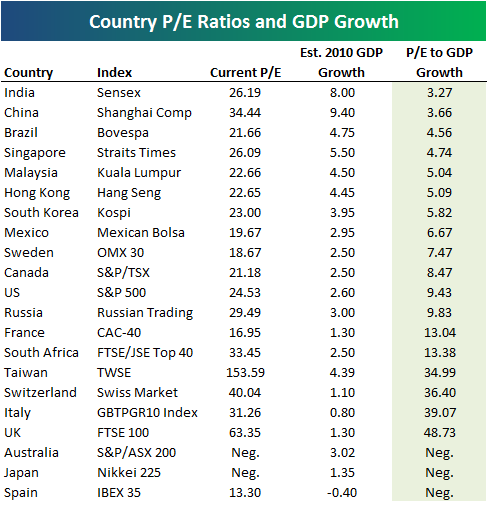
Many investors use the PEG ratio as a valuation tool these days because it puts a company's growth prospects into perspective along with the widely followed price to earnings ratio. The PEG ratio is the P/E ratio over the growth rate, and a PEG of less than one is generally considered good.
In this regard, we have created "PEG" ratios for a number of countries using the P/E ratio of each country's main equity market index along with 2010 estimated GDP growth rates. Just as with stocks, the lower the country PEG, the more attractive. As shown, India has the best PEG out of the countries we analyzed. It has a P/E ratio of 26.19 and estimated 2010 GDP growth of 8%. While its P/E isn't as low as a lot of countries, its growth rate is very high. China ranks second with a PEG of 3.66. The US ranks in the middle of the pack with a P/E of 24.53 and estimated GDP growth of 2.6%. At the bottom of the list sits Switzerland, Italy, and the UK, while Australia, Japan, and Spain have negative PEGs due to either a negative P/E ratio or negative estimated GDP growth.



.svg/600px-Flag_of_Chile_(bordered).svg.png)




+of+Copy+of+Scan+Head+Letter3.JPG)
