

10. Mar. 2010
Mar 9 - Tuesday's Prices in rupees per tonne at the Bombay Metal Exchange:
Tuesday's // Previous
Copper wire bars (HCL*) 397,000 // 397,000
Aluminum ingots 116,000 // 116,000
Zinc slab 129,000 // 129,000
Lead ingot 109,000 // 110,000 Tin
slab 912,000 // 910,000 Nickel
Cathode 1,045,000 // 1,055,000 SCRAP
Copper cable scrap 369,000 // 369,000
Copper heavy scrap 364,000 // 362,000
Copper armeture 355,000 // 355,000
Copper utensil scrap 335,000 // 335,000
Copper sheet cutting 351,000 // 352,000
Brass utensil scrap 255,000 // 256,000
Brass sheet cuttings 264,000 // 264,000
Aluminum utensil scrap 95,000 // 94,000
NOTE:- Copper rods and Copper cathode data are not been publish due to unavailability of data from the source(Hindustan Copper Ltd.)
[Reuters]
Showing posts with label Base Metals. Show all posts
Showing posts with label Base Metals. Show all posts
Aluminum Producers Cut Japan Fee, First Drop in Year
5. Mar. 2010
Aluminum producers cut the fee they charge Japanese buyers for the first time in a year as supply in Asia increased after Middle Eastern smelters began production and China restarted idled capacity.
Premiums for the three months ending June 30 have been set at $122 a metric ton over the London cash price in transactions agreed so far, down from $125 to $130 this quarter, said three executives involved in the negotiations. The fee had climbed to the highest level in at least 14 years. The executives declined to be identified because the talks are private.
Aluminum is little changed this year, after rallying 45 percent in 2009, as demand from industrialized nations is slow to recover and supply from new projects becomes available, leading to a global surplus. China, the biggest consumer of the metal used in cars and houses, cut purchases after record imports last year as local smelters resumed production.
"Aluminum stockpiles in China are ample after the nation bought more metal than necessary in anticipation of a demand recovery," said Naoki Mita, manager at Barclays Capital Japan Ltd. Given a slowdown in Chinese imports and increasing output in the Middle East, the market "will be oversupplied in the second quarter," he added.
China's imports of refined aluminum fell to 40,059 tons in January from 42,106 tons in December and 57,565 tons in November. Full-year imports surged to 1.5 million tons as the country's stockpiling agency bought more than 500,000 tons to support domestic smelters and the government's $586 billion stimulus package boosted purchases.
Chinese Smelters
Aluminum smelters in China, the largest producer, restarted as much as 5 million tons per annum of idled capacity in 2009 as profit margins improved with rising prices, according to a Feb. 8 report from Macquarie Group Ltd.
Supply to Asia rose as Norsk Hydro ASA's Qatalum smelter in Qatar started output in December. The plant will be in full production in October.
Emirates Aluminium Co., a joint venture between Abu Dhabi state-owned investment company Mubadala and Dubai Aluminium Co., started production on Dec. 1. Emal, as the venture is called, said its first output was supplied to a local client in February.
Emal agreed to supply the metal to South Korea's Daewoo International Corp., the United Arab Emirates' news agency WAM reported Feb. 10. Initial capacity of the smelter will reach 700,000 tons annually by the end of this year.
Additional Fee
Japanese buyers pay a fee in addition to the LME cash price to reflect local supply and demand and to include freight and insurance. Some deals for the second quarter are still being negotiated with offers at $124 or above, the executives said.
The premium, applied to so-called Good Western-grade aluminum ingot, more than doubled in the past year as lower shipments from Russia and record purchases by China reduced the metal availability in Asia. The fee climbed in the three months to March 31 for a third straight quarter, adding to costs for Japanese fabricators such as Furukawa-Sky Aluminum Corp. and Kobe Steel Ltd.
Aluminum for delivery in three months on the London Metal Exchange gained 0.3 percent to $2,225 a ton at 3:57 p.m. Tokyo time. The price retreated after reaching a 15-month high Jan. 6.
Ryu Sawachi, a Furukawa-Sky spokesman, said today that the company couldn't confirm the premium level. Diane Collier, a spokeswoman for Rio Tinto Group, the world's second-largest aluminum producer, didn't immediately provide a comment when reached by telephone.
[BusinessWeek]
Aluminum producers cut the fee they charge Japanese buyers for the first time in a year as supply in Asia increased after Middle Eastern smelters began production and China restarted idled capacity.
Premiums for the three months ending June 30 have been set at $122 a metric ton over the London cash price in transactions agreed so far, down from $125 to $130 this quarter, said three executives involved in the negotiations. The fee had climbed to the highest level in at least 14 years. The executives declined to be identified because the talks are private.
Aluminum is little changed this year, after rallying 45 percent in 2009, as demand from industrialized nations is slow to recover and supply from new projects becomes available, leading to a global surplus. China, the biggest consumer of the metal used in cars and houses, cut purchases after record imports last year as local smelters resumed production.
"Aluminum stockpiles in China are ample after the nation bought more metal than necessary in anticipation of a demand recovery," said Naoki Mita, manager at Barclays Capital Japan Ltd. Given a slowdown in Chinese imports and increasing output in the Middle East, the market "will be oversupplied in the second quarter," he added.
China's imports of refined aluminum fell to 40,059 tons in January from 42,106 tons in December and 57,565 tons in November. Full-year imports surged to 1.5 million tons as the country's stockpiling agency bought more than 500,000 tons to support domestic smelters and the government's $586 billion stimulus package boosted purchases.
Chinese Smelters
Aluminum smelters in China, the largest producer, restarted as much as 5 million tons per annum of idled capacity in 2009 as profit margins improved with rising prices, according to a Feb. 8 report from Macquarie Group Ltd.
Supply to Asia rose as Norsk Hydro ASA's Qatalum smelter in Qatar started output in December. The plant will be in full production in October.
Emirates Aluminium Co., a joint venture between Abu Dhabi state-owned investment company Mubadala and Dubai Aluminium Co., started production on Dec. 1. Emal, as the venture is called, said its first output was supplied to a local client in February.
Emal agreed to supply the metal to South Korea's Daewoo International Corp., the United Arab Emirates' news agency WAM reported Feb. 10. Initial capacity of the smelter will reach 700,000 tons annually by the end of this year.
Additional Fee
Japanese buyers pay a fee in addition to the LME cash price to reflect local supply and demand and to include freight and insurance. Some deals for the second quarter are still being negotiated with offers at $124 or above, the executives said.
The premium, applied to so-called Good Western-grade aluminum ingot, more than doubled in the past year as lower shipments from Russia and record purchases by China reduced the metal availability in Asia. The fee climbed in the three months to March 31 for a third straight quarter, adding to costs for Japanese fabricators such as Furukawa-Sky Aluminum Corp. and Kobe Steel Ltd.
Aluminum for delivery in three months on the London Metal Exchange gained 0.3 percent to $2,225 a ton at 3:57 p.m. Tokyo time. The price retreated after reaching a 15-month high Jan. 6.
Ryu Sawachi, a Furukawa-Sky spokesman, said today that the company couldn't confirm the premium level. Diane Collier, a spokeswoman for Rio Tinto Group, the world's second-largest aluminum producer, didn't immediately provide a comment when reached by telephone.
[BusinessWeek]


METALS-Copper down on poor OECD demand, higher dollar
4. Mar. 2010
* Dollar strengthens against euro after ECB comments.
* Chile supply fears subside.
* LME copper stocks fall.
LONDON, March 4 - Copper fell on Thursday, as investors fretted demand was cooling in China and was still weak in the OECD, while dollar strength deterred non-U.S. investors.
Benchmark copper for three-month delivery CMCU3 on the London Metal Exchange was at $7,448 a tonne at 1501 GMT from a $7,580 on Wednesday. It earlier fell 2 percent to $7,421.
Copper has eked out gains of just 0.6 percent so far this year, with Chinese buying softening as the world's top base metals consumer moves to a less accommodative monetary policy to cool rapid growth. Chinese demand helped copper surge 140 percent in 2009.
[Reuters]
* Dollar strengthens against euro after ECB comments.
* Chile supply fears subside.
* LME copper stocks fall.
LONDON, March 4 - Copper fell on Thursday, as investors fretted demand was cooling in China and was still weak in the OECD, while dollar strength deterred non-U.S. investors.
Benchmark copper for three-month delivery CMCU3 on the London Metal Exchange was at $7,448 a tonne at 1501 GMT from a $7,580 on Wednesday. It earlier fell 2 percent to $7,421.
Copper has eked out gains of just 0.6 percent so far this year, with Chinese buying softening as the world's top base metals consumer moves to a less accommodative monetary policy to cool rapid growth. Chinese demand helped copper surge 140 percent in 2009.
[Reuters]
Base Metal Prices-Mumbai - March
4. Mar. 2010
Mar 4 - Thursday's Prices in rupees per tonne at the Bombay Metal Exchange:
Thursday's // Previous
Copper wire bars (HCL*) 395,000 // 394,000
Aluminum ingots 115,000 // 115,000
Zinc slab 128,000 // 127,000
Lead ingot 109,000 // 108,000 Tin
slab 922,000 // 915,000 Nickel
Cathode 1,070,000 // 1,055,000 SCRAP
Copper cable scrap 367,000 // 366,000
Copper heavy scrap 361,000 // 360,000
Copper armeture 355,000 // 354,000
Copper utensil scrap 335,000 // 332,000
Copper sheet cutting 350,000 // 350,000
Brass utensil scrap 357,000 // 256,000
Brass sheet cuttings 263,000 // 264,000
Aluminum utensil scrap 95,000 // 92,000
NOTE:- Copper rods and Copper cathode data are not been publish due to unavailability of data from the source(Hindustan Copper Ltd.).
[Reuters]
Mar 4 - Thursday's Prices in rupees per tonne at the Bombay Metal Exchange:
Thursday's // Previous
Copper wire bars (HCL*) 395,000 // 394,000
Aluminum ingots 115,000 // 115,000
Zinc slab 128,000 // 127,000
Lead ingot 109,000 // 108,000 Tin
slab 922,000 // 915,000 Nickel
Cathode 1,070,000 // 1,055,000 SCRAP
Copper cable scrap 367,000 // 366,000
Copper heavy scrap 361,000 // 360,000
Copper armeture 355,000 // 354,000
Copper utensil scrap 335,000 // 332,000
Copper sheet cutting 350,000 // 350,000
Brass utensil scrap 357,000 // 256,000
Brass sheet cuttings 263,000 // 264,000
Aluminum utensil scrap 95,000 // 92,000
NOTE:- Copper rods and Copper cathode data are not been publish due to unavailability of data from the source(Hindustan Copper Ltd.).
[Reuters]
Japan's ME Oil Imports in Jan 2010 Announced
27. Feb. 2010
Japanese government said that Kuwait’s crude oil exports to Japan fell 24.9% in January 2010 from a year earlier to 7.74 million barrels, or 250,000 bpd, for the second consecutive monthly drop.
Kuwait supplied 6.1% of nation’s crude oil in January 2010, compared with 8.8% in January 2009 and 7.7% in December 2009, the Japanese Natural Resources and Energy Agency, a unit of the Ministry of Economy, Trade and Industry, said in a preliminary report.
Japan is Kuwait’s largest oil buyer with accounting for 20% of its total crude exports.
Japan’s overall imports of crude oil in the reporting month rose 7.6% year-on-year to 126.60 million barrels (4.08 million bpd) for the first gain in 16 month.
Shipments from the Middle East increased 7.4% to 112.13 million barrels (3.62 million bpd), and accounted for 88.6% of the total, down 0.1% points from a year before.
Saudi Arabia remained Japan’s biggest oil supplier, with imports from the kingdom rising 6.2% from a year earlier to 37.36 million barrels (1.21 million bpd), followed by the United Arab Emirates with 23.86 million barrels (770,000 bpd), down 2.5%.
Qatar ranked third, with shipments jumping 24.4% to 15.47 million barrels (499,000 bpd). Iran was fourth with 12.80 million barrels (413,000 bpd), down 19.2%.
Resource-poor Japan is the world’s third-largest oil consumer after the US and China, and it relies on crude oil imports for about 50% of its energy needs. Shipments of direct-deal, which prices are based on the average spot price of Dubai crude, the benchmark for Asia, account for about 80% of Japan’s crude imports.
[BEDigest]
Japanese government said that Kuwait’s crude oil exports to Japan fell 24.9% in January 2010 from a year earlier to 7.74 million barrels, or 250,000 bpd, for the second consecutive monthly drop.
Kuwait supplied 6.1% of nation’s crude oil in January 2010, compared with 8.8% in January 2009 and 7.7% in December 2009, the Japanese Natural Resources and Energy Agency, a unit of the Ministry of Economy, Trade and Industry, said in a preliminary report.
Japan is Kuwait’s largest oil buyer with accounting for 20% of its total crude exports.
Japan’s overall imports of crude oil in the reporting month rose 7.6% year-on-year to 126.60 million barrels (4.08 million bpd) for the first gain in 16 month.
Shipments from the Middle East increased 7.4% to 112.13 million barrels (3.62 million bpd), and accounted for 88.6% of the total, down 0.1% points from a year before.
Saudi Arabia remained Japan’s biggest oil supplier, with imports from the kingdom rising 6.2% from a year earlier to 37.36 million barrels (1.21 million bpd), followed by the United Arab Emirates with 23.86 million barrels (770,000 bpd), down 2.5%.
Qatar ranked third, with shipments jumping 24.4% to 15.47 million barrels (499,000 bpd). Iran was fourth with 12.80 million barrels (413,000 bpd), down 19.2%.
Resource-poor Japan is the world’s third-largest oil consumer after the US and China, and it relies on crude oil imports for about 50% of its energy needs. Shipments of direct-deal, which prices are based on the average spot price of Dubai crude, the benchmark for Asia, account for about 80% of Japan’s crude imports.
[BEDigest]
Alcoa Primed for Aluminum Surge
23. Feb. 2010
Alcoa(AA Quote), the third largest producer of aluminum in the world, may be among metal stocks best position to benefit from rebounding production and pricing for aluminum this year.
The metal averaged $1,420 per metric ton for spot delivery on the London Metal Exchange in January 2009, touched a high of $2,342.75 in January this year and is currently trading at $2,105 per ton. Alcoa, Aluminum Corporation of China(ACH Quote), and Alumina(AWC Quote) have already logged-in handsome gains during this rally, which saw their shares soaring 167%, 121%, and 187%, respectively.
Alcoa is preparing to handle increased aluminum demand by joining with Saudi Arabian Mining Co. (Ma'aden) in December to build a $10.8 billion aluminum complex to target the Middle East region starting 2013.
Aluminum Corp., China's largest maker of aluminum, demonstrated further confidence in the outlook for the metal by announcing plans this month to develop and operate a $1 billion smelter in Malaysia in collaboration with billionaire Syed Mokhtar Al-Bukhary. The smelter will have an initial annual production capacity of 330,000 metric tons that will eventually increase to 1.25 million tons.
After declining 14% during 2009, world aluminum production is likely to increase by 5% during 2010 to 38.5 million metric tons, according to forecasts by the Australian Bureau of Agriculture and Resource Economics (ABARE). A number of smelters that reduced output or shut down earlier are likely to restart or increase production during the year in response to the expected 8% increase in consumption.
Furthermore, ABARE forecasts an 18% increase in aluminum prices during 2010 when compared to a 34% decline last year.
[The Street]
Alcoa(AA Quote), the third largest producer of aluminum in the world, may be among metal stocks best position to benefit from rebounding production and pricing for aluminum this year.
The metal averaged $1,420 per metric ton for spot delivery on the London Metal Exchange in January 2009, touched a high of $2,342.75 in January this year and is currently trading at $2,105 per ton. Alcoa, Aluminum Corporation of China(ACH Quote), and Alumina(AWC Quote) have already logged-in handsome gains during this rally, which saw their shares soaring 167%, 121%, and 187%, respectively.
Alcoa is preparing to handle increased aluminum demand by joining with Saudi Arabian Mining Co. (Ma'aden) in December to build a $10.8 billion aluminum complex to target the Middle East region starting 2013.
Aluminum Corp., China's largest maker of aluminum, demonstrated further confidence in the outlook for the metal by announcing plans this month to develop and operate a $1 billion smelter in Malaysia in collaboration with billionaire Syed Mokhtar Al-Bukhary. The smelter will have an initial annual production capacity of 330,000 metric tons that will eventually increase to 1.25 million tons.
After declining 14% during 2009, world aluminum production is likely to increase by 5% during 2010 to 38.5 million metric tons, according to forecasts by the Australian Bureau of Agriculture and Resource Economics (ABARE). A number of smelters that reduced output or shut down earlier are likely to restart or increase production during the year in response to the expected 8% increase in consumption.
Furthermore, ABARE forecasts an 18% increase in aluminum prices during 2010 when compared to a 34% decline last year.
[The Street]
Base Metal and Scrap Prices - Mumbai
16. February. 2010
Feb 16 - Tuesday's Prices in rupees per tonne at the Bombay Metal Exchange:
Tuesday's // Previous
Copper wire bars (HCL*) 380,000 // 373,000
Aluminum ingots 113,000 // 113,000
Zinc slab 125,000 // 122,000
Lead ingot 111,000 // 108,000 Tin
slab 915,000 // 890,000 Nickel
Cathode 952,000 // 925,000 SCRAP
Copper cable scrap 352,000 // 345,000
Copper heavy scrap 347,000 // 340,000
Copper armeture 342,000 // 336,000
Copper utensil scrap 321,000 // 312,000
Copper sheet cutting 336,000 // 329,000
Brass utensil scrap 246,000 // 242,000
Brass sheet cuttings 252,000 // 251,000
Aluminum utensil scrap 91,000 // 89,000
NOTE:- Copper rods and Copper cathode data are not been publish due to unavailability of data from the source(Hindustan Copper Ltd.).
[Reuters]
Feb 16 - Tuesday's Prices in rupees per tonne at the Bombay Metal Exchange:
Tuesday's // Previous
Copper wire bars (HCL*) 380,000 // 373,000
Aluminum ingots 113,000 // 113,000
Zinc slab 125,000 // 122,000
Lead ingot 111,000 // 108,000 Tin
slab 915,000 // 890,000 Nickel
Cathode 952,000 // 925,000 SCRAP
Copper cable scrap 352,000 // 345,000
Copper heavy scrap 347,000 // 340,000
Copper armeture 342,000 // 336,000
Copper utensil scrap 321,000 // 312,000
Copper sheet cutting 336,000 // 329,000
Brass utensil scrap 246,000 // 242,000
Brass sheet cuttings 252,000 // 251,000
Aluminum utensil scrap 91,000 // 89,000
NOTE:- Copper rods and Copper cathode data are not been publish due to unavailability of data from the source(Hindustan Copper Ltd.).
[Reuters]
Why silver price will boom to $50/oz
11. February. 2010
 Silver remains very undervalued on a historical basis and is undervalued even against gold. While gold has begun to receive some interest from a small minority of retail investors, silver remains the preserve of relatively few contrarian investors and the media and financial press rarely, if ever, covers silver. And yet silver is quite likely in the intermediate stage of a bull market that will rival or surpass that of the 1970s.
Silver is currently worth less than $17.00 per ounce. It rose to a recent nominal high $20.88/oz in March 2008. After an 18 month period of correction and consolidation, silver looks set to challenge that high in the coming months. We continue to be bullish on gold and particularly silver and believe that silver will likely surpass its non inflation adjusted high of $48.70 per ounce and its inflation adjusted high of some $130 per ounce in the coming years.
Why Silver is in a Bull Market and How High Could it Go?
Precious metals has been the best performing asset classes in recent years with gold and silver outperforming equities, property and most asset classes over a 3, 5 and 10 year period. This outperformance looks set to continue in the coming months due to the very bullish fundamentals. The primary reason for our bullish outlook on silver is due to the continuing and increasing global macroeconomic, currency and geopolitical risks; silver's historic role as money and a store of value; the declining and very small supply of silver; significant industrial demand and perhaps most importantly significant and increasing investment demand.
Gold, oil and nearly every major commodity, stock indices and property market surpassed their record highs in recent years. Favourable supply and demand factors, continuing global macroeconomic and geopolitical risk and concerns regarding the emergence of inflation and stagflation as the massive global monetary and fiscal reflation affects the value of fiat currencies all point to higher silver prices in the long term.
In the 1970s silver rose from under $1.50/oz in 1970 to nearly $50/oz in 1980. Thus, silver rose by more than 25 times or by more than 2,400%. Were silver to replicate its performance in the 1970s, it would have to rise by more than 25 times again. The average price of silver in 2001 was $4.37/oz and 25 fold increase would result in silver rising to over $110/oz. While this price target may seem outlandish to some, it is worth remembering that silver's record high in 1980 adjusted for inflation (according to US government inflation figures) was some $130/oz.
Admittedly, the final phase of the silver blow off was a speculative bubble as the billionaire Hunt brothers attempted to corner the silver market. Unlike in 1979, today there are hundreds of billionaires, some multi billionaires, thousands of millionaires, hedge funds and many sovereign wealth funds. Small allocations by any of these will see sharp moves up in the price. Indeed, the silver market is so small that it could very easily be cornered again (as appears to be happened in the tin market in recent weeks). > Is Silver About Returns or a Hedge Against Inflation & Systemic Risk?
Silver is a hedge against macroeconomic, systemic and inflationary risk with the attractive added potential for significant capital gains. Real asset allocation and prudent diversification would be an important reason to have an allocation to silver. Silver is highly correlated to the safe haven of gold and is in effect a leveraged sister of the precious yellow metal. Thus, informed investors use gold more for wealth preservation purposes and silver in order to make a return.
Silver: Declining Supply
In 1900 there were 12 billion ounces of silver in the world. By 1990, the internationally respected commodities research firm CPM Group say that figure had been reduced to around 2.2 billion ounces of silver. Today, that figure has fallen to less than 1 billion ounces in above ground refined silver. It is estimated that more than 90% of all the silver that has ever been mined has been consumed by the global photography, technology, medical, defence and electronics industries.
On current supply/demand trends, the amount of above ground refined silver is projected to shrink to even lower levels in the coming years. Industrial demand has been outstripping mining supply for most of the last 20 years, driving above ground supply to historically low levels. Few in the investment world are aware of this important fact.
Silver production has been flat in recent years while demand has been increasing. This hasn't resulted in significantly higher prices yet because the world has been able to fill the gap from inventories and official government stockpiles.
However, today the U.S. government's stockpile is all but gone, and sales from other official sources, such as China, Russia and India, are declining, too. The decline in refined silver stocks, from around 2.2 billion ounces in 1990 to around 300 million ounces today means that silver stocks are near an all time low.
Very importantly, silver is very unusual as its supply is inelastic.
This means that silver production will not ramp up significantly if the silver price goes up. Supply didn't increase significantly in the 1970s when silver rose more than 35 fold in price - from $1.40/oz in 1971 to a high of nearly $50/oz in 1980. Importantly, silver is a byproduct metal and some 80% of mined silver is a byproduct of base metals. Higher prices for silver will not cause copper, nickel, zinc, lead or other base metal miners to increase their production. In the event of a global stagflationary or deflationary slowdown, demand for base metals would likely fall thus further decreasing the supply of mined silver.
There are only a handful of pure silver mines remaining - many with depleting reserves. This inflexible supply means that we cannot expect significant mine supply to depress the price after silver rises in price. It is extremely rare to find a good, service, commodity or investment that is price inelastic in both supply and demand. This is another powerfully bullish aspect unique to silver.
[Commodity Online news]

Silver is currently worth less than $17.00 per ounce. It rose to a recent nominal high $20.88/oz in March 2008. After an 18 month period of correction and consolidation, silver looks set to challenge that high in the coming months. We continue to be bullish on gold and particularly silver and believe that silver will likely surpass its non inflation adjusted high of $48.70 per ounce and its inflation adjusted high of some $130 per ounce in the coming years.
Why Silver is in a Bull Market and How High Could it Go?
Precious metals has been the best performing asset classes in recent years with gold and silver outperforming equities, property and most asset classes over a 3, 5 and 10 year period. This outperformance looks set to continue in the coming months due to the very bullish fundamentals. The primary reason for our bullish outlook on silver is due to the continuing and increasing global macroeconomic, currency and geopolitical risks; silver's historic role as money and a store of value; the declining and very small supply of silver; significant industrial demand and perhaps most importantly significant and increasing investment demand.
Gold, oil and nearly every major commodity, stock indices and property market surpassed their record highs in recent years. Favourable supply and demand factors, continuing global macroeconomic and geopolitical risk and concerns regarding the emergence of inflation and stagflation as the massive global monetary and fiscal reflation affects the value of fiat currencies all point to higher silver prices in the long term.
In the 1970s silver rose from under $1.50/oz in 1970 to nearly $50/oz in 1980. Thus, silver rose by more than 25 times or by more than 2,400%. Were silver to replicate its performance in the 1970s, it would have to rise by more than 25 times again. The average price of silver in 2001 was $4.37/oz and 25 fold increase would result in silver rising to over $110/oz. While this price target may seem outlandish to some, it is worth remembering that silver's record high in 1980 adjusted for inflation (according to US government inflation figures) was some $130/oz.
Admittedly, the final phase of the silver blow off was a speculative bubble as the billionaire Hunt brothers attempted to corner the silver market. Unlike in 1979, today there are hundreds of billionaires, some multi billionaires, thousands of millionaires, hedge funds and many sovereign wealth funds. Small allocations by any of these will see sharp moves up in the price. Indeed, the silver market is so small that it could very easily be cornered again (as appears to be happened in the tin market in recent weeks). > Is Silver About Returns or a Hedge Against Inflation & Systemic Risk?
Silver is a hedge against macroeconomic, systemic and inflationary risk with the attractive added potential for significant capital gains. Real asset allocation and prudent diversification would be an important reason to have an allocation to silver. Silver is highly correlated to the safe haven of gold and is in effect a leveraged sister of the precious yellow metal. Thus, informed investors use gold more for wealth preservation purposes and silver in order to make a return.
Silver: Declining Supply
In 1900 there were 12 billion ounces of silver in the world. By 1990, the internationally respected commodities research firm CPM Group say that figure had been reduced to around 2.2 billion ounces of silver. Today, that figure has fallen to less than 1 billion ounces in above ground refined silver. It is estimated that more than 90% of all the silver that has ever been mined has been consumed by the global photography, technology, medical, defence and electronics industries.
On current supply/demand trends, the amount of above ground refined silver is projected to shrink to even lower levels in the coming years. Industrial demand has been outstripping mining supply for most of the last 20 years, driving above ground supply to historically low levels. Few in the investment world are aware of this important fact.
Silver production has been flat in recent years while demand has been increasing. This hasn't resulted in significantly higher prices yet because the world has been able to fill the gap from inventories and official government stockpiles.
However, today the U.S. government's stockpile is all but gone, and sales from other official sources, such as China, Russia and India, are declining, too. The decline in refined silver stocks, from around 2.2 billion ounces in 1990 to around 300 million ounces today means that silver stocks are near an all time low.
Very importantly, silver is very unusual as its supply is inelastic.
This means that silver production will not ramp up significantly if the silver price goes up. Supply didn't increase significantly in the 1970s when silver rose more than 35 fold in price - from $1.40/oz in 1971 to a high of nearly $50/oz in 1980. Importantly, silver is a byproduct metal and some 80% of mined silver is a byproduct of base metals. Higher prices for silver will not cause copper, nickel, zinc, lead or other base metal miners to increase their production. In the event of a global stagflationary or deflationary slowdown, demand for base metals would likely fall thus further decreasing the supply of mined silver.
There are only a handful of pure silver mines remaining - many with depleting reserves. This inflexible supply means that we cannot expect significant mine supply to depress the price after silver rises in price. It is extremely rare to find a good, service, commodity or investment that is price inelastic in both supply and demand. This is another powerfully bullish aspect unique to silver.
[Commodity Online news]
Aluminium Prices Recover With Improved Markets Performance
11. February. 2010
Aluminium prices have gained in the domestic futures markets on account of positive sentiments from the equity bourses. The trend is still in favor of bears; however the prices have improved as traders are looking for some buying opportunities.
MCX Aluminium is trading at Rs 94.25 per kg up 0.69%. The prices can test Rs 95 per kg if momentum continues.
In a important news, Alcoa said will continue discussing ways to resolve energy costs at its aluminum smelters in Italy and will not curtail its two plants there on Feb. 6 as previously announced, a spokesman said on Friday.
"We are continuing to analyze and continuing to talk. We're hopeful that the Italian government and the European Commission can help us resolve this situation. And we'll take it from there," Kevin Lowery, spokesman for the U.S. aluminum giant.
Earlier in November, Alcoa said it would temporarily idle operations at its 194,000-tonne-per-year smelters after the European Commission ordered it to pay back most of the state aid it received in Italy since 2006.
[Bloomberg]
Aluminium prices have gained in the domestic futures markets on account of positive sentiments from the equity bourses. The trend is still in favor of bears; however the prices have improved as traders are looking for some buying opportunities.
MCX Aluminium is trading at Rs 94.25 per kg up 0.69%. The prices can test Rs 95 per kg if momentum continues.
In a important news, Alcoa said will continue discussing ways to resolve energy costs at its aluminum smelters in Italy and will not curtail its two plants there on Feb. 6 as previously announced, a spokesman said on Friday.
"We are continuing to analyze and continuing to talk. We're hopeful that the Italian government and the European Commission can help us resolve this situation. And we'll take it from there," Kevin Lowery, spokesman for the U.S. aluminum giant.
Earlier in November, Alcoa said it would temporarily idle operations at its 194,000-tonne-per-year smelters after the European Commission ordered it to pay back most of the state aid it received in Italy since 2006.
[Bloomberg]
Copper Hits Three-Month Low
5. February. 2010
OnlinWallStreetJournal
 Strength in the dollar combined with lurking worries about Chinese demand sent copper futures to a three-month low Thursday.
Copper for February delivery fell 9.25 cents, or 3.1%, to $2.8755 on the Comex division of the New York Mercantile Exchange.
The dollar's continuing gains were in the forefront, as the euro hit a a seven-month low against the dollar on festering concerns about Greek sovereign debt. A stronger dollar hurts commodities by making them more expensive for holders of other currencies.
Weaker stock markets also weighed, since that is seen as a sign of economic nervousness and thus concerns about the strength of demand for commodities. Shares fell on continuing worries about European deficits as well as an unexpected rise in U.S. weekly jobless claims and a small-than-forecasted gain in U.S productivity.
There also appears to be a slowing in Chinese demand ahead of the approaching seven-day Chinese New Year holiday, said Frank Lesh, broker and futures analyst with FuturePath Trading. However, traders will have to wait until after the holidays to ascertain whether this is due to the holiday or signals something more significant, such as declining consumption, he added.
Uncertainty over China continues to be a worry for the copper market, even though "the stronger dollar, weak equity sessions, and hot-and-cold U.S. macro readings have alternatively acted as primary bearish catalysts in the metals complex of late," said Edward Meir, analyst with MF Global.
Markets collectively anticipate monetary tightening in China. Mr. Meir also cited a downgrade of two midsize Chinese banks earlier this week by Fitch. Still, he said, China isn't likely to announce any major economic policy announcements ahead of the approaching holidays.
"However, markets are clearly on edge, as the usual bearish factors have now been joined by a new variable, that being a 'credit watch' hovering over China with potentially far-reaching implications," he said.
Still, analyst with Barclays cited some encouraging signs for base metals, including a slowing of recent deliveries into London Metal Exchange warehouses. Inventories of copper stored in London Metal Exchange warehouses fell 1,050 metric tons Thursday, leaving them at 539,425 tons.
OnlinWallStreetJournal

Copper for February delivery fell 9.25 cents, or 3.1%, to $2.8755 on the Comex division of the New York Mercantile Exchange.
The dollar's continuing gains were in the forefront, as the euro hit a a seven-month low against the dollar on festering concerns about Greek sovereign debt. A stronger dollar hurts commodities by making them more expensive for holders of other currencies.
Weaker stock markets also weighed, since that is seen as a sign of economic nervousness and thus concerns about the strength of demand for commodities. Shares fell on continuing worries about European deficits as well as an unexpected rise in U.S. weekly jobless claims and a small-than-forecasted gain in U.S productivity.
There also appears to be a slowing in Chinese demand ahead of the approaching seven-day Chinese New Year holiday, said Frank Lesh, broker and futures analyst with FuturePath Trading. However, traders will have to wait until after the holidays to ascertain whether this is due to the holiday or signals something more significant, such as declining consumption, he added.
Uncertainty over China continues to be a worry for the copper market, even though "the stronger dollar, weak equity sessions, and hot-and-cold U.S. macro readings have alternatively acted as primary bearish catalysts in the metals complex of late," said Edward Meir, analyst with MF Global.
Markets collectively anticipate monetary tightening in China. Mr. Meir also cited a downgrade of two midsize Chinese banks earlier this week by Fitch. Still, he said, China isn't likely to announce any major economic policy announcements ahead of the approaching holidays.
"However, markets are clearly on edge, as the usual bearish factors have now been joined by a new variable, that being a 'credit watch' hovering over China with potentially far-reaching implications," he said.
Still, analyst with Barclays cited some encouraging signs for base metals, including a slowing of recent deliveries into London Metal Exchange warehouses. Inventories of copper stored in London Metal Exchange warehouses fell 1,050 metric tons Thursday, leaving them at 539,425 tons.
Base Metals Copper and Zinc Price
5. February. 2010
CommodityOnline New
 Base metal prices declined on Wednesday as strength in the dollar coupled with fresh concerns of widening European debt convinced investors to cut their risk appetite. Lower risk appetite in the financial markets led to demand for the dollar and the strength in the dollar made base metals look unattractive for holders of other currencies.
Copper prices slipped sharply from a high of $6948 on the LME to close at $6590. Inventories of the red metal declined 675 tonnes but even this factor could not cushion the downside in the red metal as the dollar gained broadly against all currencies.
Global stainless steel maker Outokumpu said that the fundamental scenario still remains bleak and investors might be pricing in a stronger demand recovery. Stock levels in Europe and China are at normal levels and may not require re-stocking immediately.
Base metal prices could face pressure on the downside as the still-fragile phase of economic recovery in the Europe and the US and the limp physical demand from the industrial sector could act as a negative factor on prices.
Base metal prices could come under pressure on the back of a stronger dollar. Risk aversion in the financial markets could lead to lower demand for higher-yielding and riskier investment assets. Concerns over economic recovery could lead to doubts over the pace of demand recovery for base metals.
On the macroeconomic front, the US Dollar could trade with a positive bias on concern that Asia-Pacific region’s economic recovery will slow and European nations may struggle to reduce their debts. This could lead to increased demand for the low-yielding dollar and the US Dollar could strengthen.
Copper – Copper prices are up with immediate support for MCX February contract seen at Rs.297.00. Further below, crucial support is seen at 289.00 levels. Whereas resistance is seen at Rs.308.05 levels & further upwards at Rs. 315 levels.
Zinc - Zinc prices are trading up with immediate support seen at Rs.94.40 levels for MCX February contract whereas crucial support is seen at Rs.92.25 level. Short-term resistance is seen at Rs.98.20 whereas major resistance is seen at Rs 100.90 levels.
CommodityOnline New
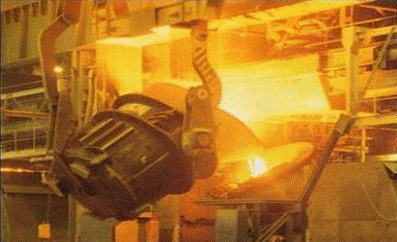
Copper prices slipped sharply from a high of $6948 on the LME to close at $6590. Inventories of the red metal declined 675 tonnes but even this factor could not cushion the downside in the red metal as the dollar gained broadly against all currencies.
Global stainless steel maker Outokumpu said that the fundamental scenario still remains bleak and investors might be pricing in a stronger demand recovery. Stock levels in Europe and China are at normal levels and may not require re-stocking immediately.
Base metal prices could face pressure on the downside as the still-fragile phase of economic recovery in the Europe and the US and the limp physical demand from the industrial sector could act as a negative factor on prices.
Base metal prices could come under pressure on the back of a stronger dollar. Risk aversion in the financial markets could lead to lower demand for higher-yielding and riskier investment assets. Concerns over economic recovery could lead to doubts over the pace of demand recovery for base metals.
On the macroeconomic front, the US Dollar could trade with a positive bias on concern that Asia-Pacific region’s economic recovery will slow and European nations may struggle to reduce their debts. This could lead to increased demand for the low-yielding dollar and the US Dollar could strengthen.
Copper – Copper prices are up with immediate support for MCX February contract seen at Rs.297.00. Further below, crucial support is seen at 289.00 levels. Whereas resistance is seen at Rs.308.05 levels & further upwards at Rs. 315 levels.
Zinc - Zinc prices are trading up with immediate support seen at Rs.94.40 levels for MCX February contract whereas crucial support is seen at Rs.92.25 level. Short-term resistance is seen at Rs.98.20 whereas major resistance is seen at Rs 100.90 levels.
Subscribe to:
Posts (Atom)


+of+Copy+of+Scan+Head+Letter3.JPG)
